


Reactive vs Proactive Road Safety: Towards a Smarter, Integrated Approach
September 2026
Road safety assessment has traditionally relied on the analysis of traffic collisions and casualties to identify high‑risk locations. Over the past 25 years, however, proactive approaches have emerged, based on risk models that estimate the likelihood and severity of crashes—such as iRAP, Network Wide Assessment (NWA-P), Network Safety Screening (NSS), and the “méthode sûre.” These frameworks shift the focus from observed incidents to underlying infrastructure and exposure-related risk factors. Understanding not only the differences between reactive and proactive approaches, but, more importantly, their complementarities is essential to improve the identification, prioritisation, and treatment of high‑risk locations within increasingly complex road networks.

Reactive Approach: Learning from Crashes
The reactive method is based on the analysis of historical crash data. By identifying locations with high accident frequency or severity-commonly referred to as “crash hotspots”-authorities can prioritise interventions where harm has already occurred. KeyACCIDENT is a very popular software used in the UK.
This approach has the advantage of being evidence-based and widely accepted, often forming the backbone of national safety strategies. However, it has its limitations:
• It depends on data availability and quality, which can be inconsistent
• It is inherently retrospective, acting only after incidents occur
• It may overlook emerging risks or underreported areas
In urban environments, where mobility patterns evolve rapidly, relying solely on past crashes can result in delayed responses to current risks.
Proactive Approach: Anticipating Risk
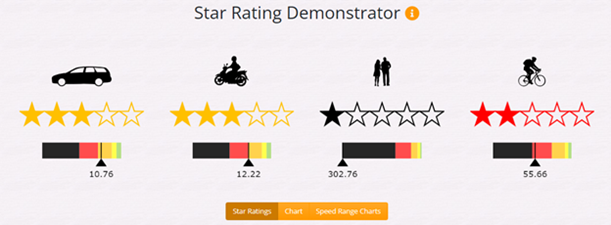
In contrast, the proactive approach focuses on infrastructure-based risk assessment, independent of crash history. Frameworks such as iRAP Star Ratings evaluate road design, operating conditions, roadside hazards, speed environments, and facilities for vulnerable users to predict the likelihood and severity of crashes.
This method enables:
- Network-wide assessments, including roads with little or no crash data
- Identification of “hidden risk zones”
- Alignment with Safe System and Vision Zero principles
Star Rating Demonstrator (Credits: Austroads)
With the rise of AI-powered tools such as VERALYTIX Scan, proactive assessments can now be performed at scale using computer vision and geospatial data, transforming what was once a complex, resource-intensive exercise into a repeatable and scalable process.
From Detection to Prediction
While both approaches provide valuable insights, neither is sufficient alone. The most effective strategy lies in their combination.
Reactive analysis highlights where crashes have already occurred, while proactive assessment explains where and why they are likely to happen elsewhere. Together, they enable a more comprehensive identification of high-risk locations across a network.
The next frontier is to go even further—with predictive safety methods. By focusing on near-miss detection and behavioural indicators, solutions such as VERALYTIX allow practitioners to identify risk patterns before crashes happen. This adds a dynamic, real-time dimension to safety management, bridging the gap between infrastructure risk and actual road user behaviour.
In this integrated framework:
- Reactive methods validate known risks
- Proactive methods scale risk detection
- Predictive methods anticipate future incidents
This combination provides a powerful, data-driven pathway to prioritise interventions, optimise investments, and ultimately save lives—more efficiently and proactively than ever before.
Ready to put proactive risk assessment into practice at scale? VERALYTIX, specifically VERALYTIX Scan brings AI-assisted data collection and iRAP-aligned inspection workflows to road networks of any size.